Friday, May 18, 2012

A speed counts Blog by Donie


10 of the fastest land animals on earth
Speed does matter a lot in wild life, be it for saving your life from the hunters or predators, or for catching your prey for food. This is a list of land animals with highest running speed.  

 
(1) Cheetah:The cheetah (Acinonyx jubatus), a member of the feline family, lives primarily in parts of Africa and the Middle East. The cheetah clocks in at an impressive, chart-topping speed of 71mph (114 kph). It can sprint at these speeds over short distances. Since they run so fast, cheetahs take about 30 minutes to catch their breath after a chase before they can begin eating their catch.
 
(2) Pronghorn: With its slightly hooked horns, caramel-colored coat and white underside, the pronghorn closely resembles an antelope. Dwelling in Southern Africa, it grazes upon the grasses and shrubbery near rocky hillsides or semi-desert plains. To escape from predators, the pronghorn gallops at up to 57 mph (95 kph).
 
(3) Springbok: The springbok (Antidorcas marsupialis), or antelope, also looks similar to the Grant's Gazelle, with a light brown coat, black horizontal stripe, white belly and sharp, ringed horns. It can run up to 53 mph (85 kph) and can leap up to about 13 feet (4 meters) in the air.
 
(4) Blue Wildebeest: The blue wildebeest (Connochaetes taurinus), a large antelope, can be found in the plains and woods of Southern and East Africa. The blue wildebeest gets its name from the silvery blue sheen of its hide, and it has shaggy tufts of hair on its head and down its back. It's capable of reaching speeds of 50 mph (80 kph).
 
(5) Lion: The king of the jungle can charge at speeds of more than 50mph (80 mph) — but only over short distances. That's why lions sneak up on their prey as a group, carefully closing in on the animal from various angles, before quickly running in to attack.
 
(6) Thomson's Gazelle: The Thomson's gazelle (Eudorcas thomsonii) looks similar to Grant's Gazelle, but is noticeably smaller and has a white patch on its rump that extends beyond its tail onto its back. The animal can reach speeds of 50 mph (80 kph) and roams about the open, grassy plains of Africa.
(7) Grant's Gazelle: Also found only in Africa, the Grant's gazelle (Nanger granti)has a tan coat with a horizontal black strip and a white belly. This gazelle has long, dark horns that are pointy and only slightly curved. It can run as fast as47 mph (76 kph).
 
(8) Cape Hunting Dog: Found only in Africa, the cape hunting dog (Lycaon pictus) is also known as the African hunting dog and the painted hunting dog because of the unusual black spatters of spotting on its tawny coat. The wild dogs can run at speeds of up to 45 mph (72 kph).
 
(9) Brown Hare:The long and powerful hind legs of the brown hare (Lepus capensis) allow it to run at speeds of 45 mph (72 kph). Widespread over Europe, Asia and Africa, the brown hare lives aboveground and does not build burrows in the ground like 
 
(10) Coyote: Like wolves, coyotes (Canis latrans)howl and use scent marking to determine their territory, though they live alone or in pairs, not in social groups like wolves. They can be found in Canada, Mexico and throughout the United States, including upstate New York. Coyotes normally run at speeds of 25 to 30 miles an hour (40 to 48 kilometers per hour), but they can run at up to 43 mph (69 kph) when pursued.


Tuesday, May 15, 2012

Unusual items that flew into Space

9 Weird & Unusual Things That Flew on NASA's Space Shuttle
Space shuttle Atlantis stands on Launch Pad 39A at NASA's Kennedy Space Center in Florida, where it is set to liftoff on STS-135, the final shuttle mission.   
Space shuttle Atlantis stands on Launch Pad 39A at NASA's Kennedy Space Center in Florida, where it is set to liftoff on STS-135, the final shuttle mission.
When NASA's space shuttles launch into orbit, they don't just carry astronauts and supplies into the final frontier. There's a lot of other weird stuff that makes the out-of-this-world journey, too.
NASA's last space shuttle mission will launch Friday, July 8 on the Atlantis orbiter to deliver spare parts to the International Space Station. The mission will be the 135th and last flight for the program, which began in 1981.
But over the course of 30 years, the space shuttles have flown some peculiar objects into orbit. The list of odd stuff that flew aboard the shuttles is a long one, and includes the Olympic torch, a replica of the golden spike from the First Transcontinental Railroad, and rocks from the top of Mount Everest and the surface of the moon, just to name a few. 
Here nine recent space oddities carried into orbit on NASA shuttles:
(1) Cans of Coca-Cola & Pepsi
In 1985, special modified cans of Coca-Cola and Pepsi soda rode aboard the space shuttle Challenger on its STS-51F mission. The trip added more fuel to the so-called "Cola Wars" between the Coca-Cola Company and Pepsi, Co.
"Originally, only Coca-Cola was scheduled to fly," said Robert Pearlman, editor of collectSPACE.com, a website that tracks space-flown artifacts, and a SPACE.com contributor. "In addition to their desire to offer carbonated beverages for astronauts, Coca-Cola was also observing the effects of spaceflight on changes in taste perception with the goal of understanding altered tastes among target populations on Earth, such as the elderly."
"When Pepsico Inc. learned Coca-Cola was aboard, they approached NASA to fly as well, and quickly devised their own shaving cream can-inspired design," said Pearlman.
The cans, which were officially dubbed the Carbonated Beverage Dispenser Evaluation payload, were part of an experiment by the two soft drink giants to test packaging and methods of dispensing the liquids in a microgravity environment.
At the end of Challenger's mission, however, the astronaut crewmembers deemed the experiment a failure due to the lack of refrigeration and insufficient protection from microgravity effects. [Most Memorable Space Shuttle Missions]
Coca-Cola later flew a dispenser specially designed for microgravity to give astronauts the opportunity to enjoy Coke and Diet Coke in space. The dispenser flew during the space shuttle Discovery's STS-63 mission in 1995. The beverages were dispensed into sealed drinking cups and the liquid was chilled on the spot using cooling coils attached to the storage container.
A second-generation dispenser was also flown on Endeavour's STS-77 mission in 1996. This version held Coke, Diet Coke and Powerade, an energy drink. The device, however, did not work as expected on orbit.
(2) The New York Mets' Home Plate
Astronaut Saves Shea Stadium Home PlateAstronauts Mike Massimino (right) and Mike Good, STS-125 mission specialists, with home plate from New York City's Shea Stadium during a break from their training in the JSC Neutral Buoyancy Lab. Massimino brought the plate aboard the Space Shuttle Atlantis for the trip to Hubble.
In 2009, as the New York Mets organization prepared to move its baseball team into the new Citi Field in Queens, N.Y., a piece of hardware from the team's old home, Shea Stadium, made a special trip into space. On May 11, 2009, the home plate from Shea Stadium launched into orbit on the space shuttle Atlantis' STS-125 mission the last trip to the Hubble Space Telescope.
"The only problem was the plate wouldn't fit as is into the shuttle's locker designated for memorabilia," said Pearlman. "Rather than leave it 'home,' Massimino was able to trim off the plate’s black-colored border using a razor, flying just the 'white part.' The two parts were reunited once the plate was back on the ground."
Astronaut Mike Massimino, a New Yorker and devoted Mets fan, brought the plate with him and his six crewmates on their mission to overhaul the aging Hubble Space Telescope. After journeying into space, the plate was returned to Earth, and Massimino was invited to throw out the ceremonial first pitch at a baseball game upon his return.
Shea Stadium in Queens's Flushing neighborhood was demolished after serving as the home of the Mets from 1964 until 2008. The Mets placed the flown plate on display in Citi Field, which opened its doors in the spring of 2009.
(3) Buzz Lightyear To Infinity and Beyond!

Buzz Lightyear floats aboard the International Space Station during his 468 day mission.
As part of an educational and public outreach mission, NASA teamed up with Disney to launch an action figure of the beloved character Buzz Lightyear, from Disney-Pixar's film "Toy Story," into space. A 12-inch tall Buzz flew to the International Space Station on Discovery's STS-124 mission in May 2008.
The intrepid figurine spent a whopping 468 days at the orbiting outpost, during which time he starred in educational videos as part of joint NASA and Disney outreach programs. After more than a year in space, Buzz hitched a ride back to Earth on Discovery's STS-128 mission, which landed at Edwards Air Force Base in California on Sept. 11, 2009.
On Oct. 2, 2009, the action figure was even treated to a ticker tape parade at Walt Disney World in Florida to celebrate the successful completion of his long-duration mission in space.
"Joining Lightyear for his hero’s welcome back to the 'Happiest Place on Earth' was his namesake, Buzz Aldrin. Disney asked permission to name the cartoon space ranger after the real moonwalker before the first 'Toy Story' movie was released in 1995," Pearlman said.
(4) Luke Skywalker's Lightsaber
NASA Shuttle to Launch Luke Skywalker's Lightsaber The original lightsaber used by Luke Skywalker in the film 'Star Wars' will fly to the real space station on shuttle Discovery's STS-120 mission in October.
Fans of the iconic "'Star Wars" films celebrated a moment where fiction met reality, when a lightsaber prop from the sci-fi movies flew on the space shuttle Discovery's STS-120 mission.
"The lightsaber's flight was of particular interest to one STS-120 crew member, a self-described big 'Star Wars' fan who also woke during the mission to the theme from the movies," said Pearlman. "The song was chosen by Parazynski's son, who just happens to be named Luke."
One of Luke Skywalker's lightsabers was stowed onboard Discovery as it launched to the International Space Station to deliver a new module to the orbiting laboratory on Oct. 23, 2007. The prop was the original one used by actor Mark Hamill, who played Skywalker, in director George Lucas' 1977 film "Star Wars: Episode VI - Return of the Jedi."
The lightsaber flew to the space station and back to mark the 30th anniversary of the film franchise. Lucas was in attendance to watch the STS-120 launch, and at the end of the mission, the Jedi weapon was returned to him and his company, LucasFilm.
(5) Ashes of Star Trek's Creator
Roddenberry's wife, Majel Barrett Roddenberry, died in 2008, and her ashes, along with some of her husband's, 
In a fitting way to immortalize Star Trek's creator, Gene Roddenberry, some of the sci-fi legend's ashes were flown in a small capsule on the space shuttle Columbia's STS-52 mission in 1992. Columbia delivered the tiny canister into outer space, where it orbited the Earth 160 times before being returned on the shuttle.
"To the best of everyone's knowledge, it was the first time that human remains were launched on a manned spacecraft," Pearlman said.
A portion of Roddenberry's ashes were also launched into space in 1997 by the Houston-based firm Celestis, Inc., which offers a range of memorial spaceflight services. The remains of Roddenberry, who died in 1991, journeyed into the cosmos along with 23 other peoples' ashes in the company's debut Founders Flight, aboard an Orbital Sciences Pegasus rocket.
Roddenberry's wife, Majel Barrett Roddenberry, died in 2008, and her ashes, along with some of her husband's, will be launched on Celestis' Voyager Memorial Spaceflight Service, which is slated for 2012.
(6) Sports Jerseys of All Kinds
Shuttle Astronauts Share Space Through Souvenirs
Examples of patches, pins and more onboard shuttle Discovery.
Astronauts, like anyone else, have their favorite sports teams and players. As a result, many spaceflyers have chosen to show their team spirit by taking jerseys into space with them.
In just one example, Discovery's STS-124 astronauts represented a mixed bag of team allegiances. Among the items flown on Discovery, which launched on May 31, 2008, was the last game-worn jersey from Craig Biggio, a former second baseman, catcher and outfielder for the Houston Astros. Biggio played his entire 20-year career for the Astros and made his final Major League Baseball appearance on Sept. 30, 2007 before retiring from the sport.
A back-up Super Bowl XLII jersey belonging to New York Giants quarterback Eli Manning also made the journey aboard Discovery. Manning and the Giants defeated the New England Patriots to win Super Bowl XLII in 2008, and Manning was named the game's Most Valuable Player.
Four of Discovery's STS-124 astronauts hail from the New York/New Jersey area, which is home to the Giants, and NASA's astronauts all live and train for their missions at Johnson Space Center in Houston, located south of the Astros' home, Minute Maid Park.
“Not all flown jerseys came from ball-involved sports. STS-124 astronaut Karen Nyberg took with her one of cyclist Lance Armstrong's yellow Tour de France jerseys,” said Pearlman.
(7) Jamestown Colony Cargo Tag
NASA to Launch Jamestown Artifact, Coins Aboard Shuttle
This lead cargo tag -- which reads "Yames Towne" -- is believed to have been discarded from a shipping crate or trunk arriving at Jamestown, the site of the first permanent English settlement in the Americas, from England in about 1611. NASA will fly this artifact and two sets of Jamestown commemorative coins aboard Space Shuttle Atlantis in March 2007.
A small piece of history, in the form of a metal cargo tag from the Jamestown colony, flew aboard the space shuttle Atlantis on its STS-117 mission in June 2007. The historic tag was unearthed at Jamestown, the location of the first permanent English settlement in the Americas in 1607.
Essentially a colonial version of a modern-day luggage tag, the plaque, which is etched with the name of its destination, "Yames Towne," was likely used to mark merchandise that had been stored in London before being shipped, according to the Historic Jamestowne website.
The marker effectively logged more than four million miles over the course of four centuries, traveling first from England to the early American settlement, and then, 400 years later, to the International Space Station and back.
NASA flew the cargo tag with four commemorative coins on Atlantis to honor early American explorers. The historic metal piece was returned to Historic Jamestowne at the end of the flight for display in a museum.
"The same flight that launched the Jamestown tag also carried notable metal tokens of another type Monopoly board game pieces," said Pearlman. "The game pieces came from the Here & Now” edition of the popular real estate game, which featured a property square for NASA's Johnson Space Center in Houston, Texas."
(8) NASCAR Starter Flags
'Columbus' Compass,' Crew Mementos Ride Aboard Shuttle AtlantisNASA is taking three green starter's flags from the Daytona 500 into space to mark the 50th anniversary of NASA and NASCAR's premiere race.
As the final minutes ticked down toward Atlantis' launch on its STS-122 mission on Feb. 7, 2008, it may have been more appropriate for NASA's launch director to state, "gentlemen, start your space shuttle main engines." After all, the orbiter was taking three NASCAR starter flags with it on its flight into space.
Three green starter flags were packed on the shuttle in celebration of the agency's 50th anniversary and the 50th year of NASCAR's Daytona 500 race. Atlantis deliver the European science laboratory, Columbus, to the International Space Station.
After an 11-day flight, the flags were returned to Earth. One was presented to Ryan Newman, the winner of the 2008 Daytona 500. The second was placed on public display at the Florida racetrack, and the third was kept by NASA as a special commemorative piece.
"Just one of Atlantis' main gear tires, on which the NASCAR flags landed, could carry the load of the entire starting line-up of a NASCAR race 40 race cars all hitting the pavement at 250 miles per hour," Pearlman said.
(9) Dirt from Yankee Stadium
NASA Astronaut Readapts to Life on EarthAstronaut Garrett Reisman, Expedition 16/17 flight engineer, poses for a photo after signing the Expedition 16 patch, which was added to the growing collection of insignias representing crews who performed spacewalks from the Quest Airlock of the ISS.
A vial of dirt from the pitcher's mound at Yankee Stadium, the home of Major League Baseball's New York Yankees, flew on the space shuttle Endeavour's STS-123 mission in 2008.
Astronaut Garrett Reisman, a fervent Yankee fan, brought the small container of dirt with him, along with other mementos of his favorite team, including a banner and hat autographed by George Steinbrenner, who was the principal owner of the team for 37 years, from 1973 to his death in July 2010.
In a cosmic first, Reisman threw out the ceremonial first pitch via video from the International Space Station prior to the start of the Yankees' game versus the Boston Red Sox on April 16, 2008. Reisman's pitch in microgravity was the first one from space in Yankee Stadium's history.
"Launching on the space shuttle and living aboard the International Space Station is a once-in-a-lifetime experience," Reisman said at the time. "But as a lifelong Yankees fan, throwing out the first pitch at a Yankees-Red Sox game is also a once-in-a-lifetime experience. I am really honored to have this opportunity in such a historic season in the House that Ruth Built, and I would like to thank the Yankees for being so supportive of our mission up here in space. From Earth's orbit, but still deep inside the Yankees Universe, let me say, 'Go Yanks!'"

Sunday, May 13, 2012

The facts of life & Sex by Donie

New Survey revelations: 
Amours women & their sexiest time'
    
A recent and new survey uncovers the time that a woman is most likely to want to engage in sexual activity.
The survey has concluded that around 11pm on a Saturday night is the most common time for a woman to feel amorous.
However, for many, having sex in the bedroom is not necessary on the agenda.
Forty per cent of the 1,000 women questioned in the Women's Health survey admitted to having “al fresco sex”.
Regular lovemaking outside was labelled the “most exciting” way to become aroused, followed by sex at work and on the beach, the Huffington Post reported.
It also found women in the South West, North West and Scotland were the most sexually satisfied with more in four in five females saying they were happy with their sex life.
In contrast the sex lives of Irish females’ were cited as the least satisfying, with less than a third saying they were happy with their love life.
But more than 40 per cent of women living in Ireland were found to attempt sex more than three times a week.
A third of Londoners and Welsh women also admitted to having sex on more than three occasions every week, according to the survey for Women’s Health magazine.
“It is great to see that the majority of British women are satisfied between the sheets, or outside, as our … sex survey reveals,” said Farrah Storr, the magazine’s editor.

Irish women the least satisfied in bed
IRISH women might be the friskiest in Europe but they are far from happy with their bedroom antics.
   
A massive seven out of ten say they are not satisfied with their night-time nookie.
A study of the sex habits of girls across the EU was carried out by Women’s Health magazine.
When it comes to action between the sheets lusty Irish ladies are the busiest on the Continent. A bedspring-busting 42 per cent of them have sex more than three times a week.
And their perfect time for frolicking fun is revealed to be 11pm on Saturday night.
The research was conducted to discover the truth behind women’s sex lives in Europe and the difference in sexual appetites.
It found, overall, that ladies from Scotland and South West England are more sexually satisfied.
After saucy Irish gals, Londoners and Welsh women have the most sex, with one-third getting busy three times a week.
Regular lovemaking outdoors was labelled the ‘most exciting’ way to get hot and steamy, followed by sex at work (five per cent) and on the beach (nine per cent). Making love outside emerged as the biggest turn-on, with 40 per cent admitting it’s their fantasy.
But not all the 1,000 women polled seek naughty sexual thrills, as 28 per cent said the only place they have had sex was at home.
Women’s Health editor Farrah Storr said: “It is great to see that the majority of women are satisfied between the sheets, or outside, as our sex survey reveals.”

Sex After Heart Attack? 
Doctors giving the OK May Be the Key
However, a study found that most patients don't discuss the topic with a physician
    
Heart attack survivors are more likely to resume their sex lives if doctors reassure them it's safe, a new study shows.
University of Chicago Medicine researchers surveyed nearly 1,900 heart attack survivors for the study. Among patients who were sexually active before their heart attack, those who received counseling about sex before they were discharged from the hospital were 1.5 times more likely to carry on with their sex lives.
Patients who did not receive medical advice about their sex lives often either unnecessarily delayed their return to sexual activity or refrained from sex altogether.
The study also found that less than half of male patients and about one-third of female patients recalled receiving pre-discharge instructions on when to return safely to sexual activity.
One year after being discharged from the hospital, only 41 percent of men and 24 percent of women said they'd had a discussion with their doctor about sex since their heart attack.
The findings, published in the May 10 issue of the American Journal of Cardiology, show the need for doctors to regard sex as an important part of overall function, even after a life-threatening event such as a heart attack, said study author Dr. Stacy Tessler Lindau, an associate professor of obstetrics and gynecology at the University of Chicago Medicine.
"Doctors need to understand the significant role they play in helping [heart attack] patients avoid needless fear and worry about the risk of relapse or even death with return to sexual activity," Lindau said in a university news release.
"Receiving instructions prior to hospital discharge about resuming sex was a major predictor of whether patients resumed sexual activity in the year following [heart attack]," Lindau said. "For women, this was the only significant predictor. The discharging cardiologist has detailed knowledge of the patient's condition, has provided lifesaving care and is best positioned to advise on the safety of engaging in physical activity, including sex."
If heart attack survivors don't receive professional advice, they have to make their own, often incorrect, assumptions about the risks associated with sexual activity, Lindau said.

Monday, May 7, 2012

Facts about yourself & things you may not know


Things You Did not know About Yourself
    
The human body is truly a great machine, its sweaty, fluid-filled mechanism, constantly moving and mixing chemicals with precision and coordination, making everything from memories to mucus.
Here we explore some of the very complex and beautiful or just plain gross mysteries of how we function.

Your Skin Has Four Colors
All skin, without coloring, would appear creamy white. Near-surface blood vessels add a blush of red. A yellow pigment also tints the canvas. Lastly, sepia-toned melanin, created in response to ultraviolet rays, appears black in large amounts. These four hues mix in different proportions to create the skin colors of all the peoples of Earth.
The World Laughs With You
  
Just as watching someone yawn can induce the behavior in yourself, recent evidence suggests that laughter is a social cue for mimicry. Hearing a laugh actually stimulates the brain region associated with facial movements. Mimicry plays an important role in social interaction. Cues likesneezing, laughing, crying and yawning may be ways of creating strong social bonds within a group.
Big Brains Cause Cramped Mouths
Evolution isn't perfect. If it were, we might have wings instead of wisdom teeth. Sometimes useless features stick around in a species simply because they're not doing much harm. But wisdom teeth weren't always a cash crop for oral surgeons. Long ago, they served as a useful third set of meat-mashing molars. But as our brains grew our jawbone structure changed, leaving us with expensively overcrowded mouths.
Cell Hairs Move Mucus
Most cells in our bodies sport hair-like organelles called cilia that help out with a variety of functions, from digestionto hearing. In the nose, cilia help to drain mucus from the nasal cavity down to the throat. Cold weather slows down the draining process, causing a mucus backup that can leave you with snotty sleeves. Swollen nasal membranes or condensation can also cause a stuffed schnozzle.
Puberty Reshapes Brain Structure, Makes for Missed Curfews
We know that hormone-fueled changes in the body are necessary to encourage growth and ready the body forreproduction. But why is adolescence so emotionally unpleasant? Hormones like testosterone actually influence the development of neurons in the brain, and the changes made to brain structure have many behavioral consequences. Expect emotional awkwardness, apathyand poor decision-making skills as regions in the frontal cortex mature.
Thousands of Eggs Unused by Ovaries
When a woman reaches her late 40s or early 50s, the monthly menstrual cycle that controls her hormone levels and readies ova for insemination ceases. Her ovaries have been producing less and less estrogen, inciting physical and emotional changes across her body. Her underdeveloped egg follicles begin to fail to release ova as regularly as before. The average adolescent girl has 34,000 underdeveloped egg follicles, although only 350 or so mature during her life (at the rate of about one per month). The unused egg follicles then deteriorate. With no potential pregnancy on the horizon, the brain can stop managing the release of ova.
Much of a Meal is Food For Thought
Though it makes up only 2 percent of our total body weight, the brain demands 20 percent of the body's oxygen and calories. To keep our noggin well-stocked with resources, three major cerebral arteries are constantly pumping in oxygen. A blockage or break in one of them starves brain cells of the energy they require to function, impairing the functions controlled by that region. This is a stroke.
Bones Break (Down) to Balance Minerals
In addition to supporting the bag of organs and musclesthat is our body, bones help regulate our calcium levels. Bones contain both phosphorus and calcium, the latter of which is needed by muscles and nerves. If the element is in short supply, certain hormones will cause bones to break down�upping calcium levels in the body�until the appropriate extracellular concentration is reached.
Body Position Affects Your Memory
Can't remember your anniversary, hubby? Try getting down on one knee. Memories are highly embodied in our senses. A scent or sound may evoke a distant episode from one's childhood. The connections can be obvious (a bicycle bell makes you remember your old paper route) or inscrutable. A recent study helps decipher some of this embodiment. An article in the January 2007 issue ofCognition reports that episodes from your past are remembered faster and better while in a body position similar to the pose struck during the event.
Your Stomach Secretes Corrosive Acid
There's one dangerous liquid no airport security can confiscate from you: It's in your gut. Your stomach cells secrete hydrochloric acid, a corrosive compound used to treat metals in the industrial world. It can pickle steel, but mucous lining the stomach wall keeps this poisonous liquid safely in the digestive system, breaking down lunch.

The top 10 Things that Make us Humans Special
Humans are unusual animals by any stretch of the imagination, ones that have changed the face of the world around us. What makes us so special when compared to the rest of the animal kingdom? Some things we take completely for granted might surprise you.
1
Speech
The larynx, or voice box, sits lower in the throat in humans than in chimps, one of several features that enable human speech. Human ancestors evolved a descended larynx roughly 350,000 years ago. We also possess a descended hyoid bone this horseshoe-shaped bone below the tongue, unique in that it is not attached to any other bones in the body, allows us to articulate words when speaking.
2
Upright Posture
Humans are unique among the primates in how walking fully upright is our chief mode of locomotion. This frees our hands up for using tools. Unfortunately, the changes made in our pelvis for moving on two legs, in combination with babies with large brains, makes human childbirth unusually dangerous compared with the rest of the animal kingdom. A century ago, childbirth was a leading cause of death for women. The lumbar curve in the lower back, which helps us maintain our balance as we stand and walk, also leaves us vulnerable to lower back pain and strain.
3
Nakedness
We look naked compared to our hairier ape cousins. Surprisingly, however, a square inch of human skin on average possesses as much hair-producing follicles as other primates, or more humans often just have thinner, shorter, lighter hairs.
4
Hands
Contrary to popular misconceptions, humans are not the only animals to possess opposable thumbs most primates do. (Unlike the rest of the great apes, we don't have opposable big toes on our feet.) What makes humans unique is how we can bring our thumbs all the way across the hand to our ring and little fingers. We can also flex the ring and little fingers toward the base of our thumb. This gives humans a powerful grip and exceptional dexterity to hold and manipulate tools with.
5
Extraordinary Brains
Without a doubt, the human trait that sets us apart the most from the animal kingdom is our extraordinary brain. Humans don't have the largest brains in the world those belong to sperm whales. We don't even have the largest brains relative to body size many birds have brains that make up more than 8 percent of their body weight, compared to only 2.5 percent for humans. Yet the human brain, weighing only about 3 pounds when fully grown, give us the ability to reason and think on our feet beyond the capabilities of the rest of the animal kingdom, and provided the works of Mozart, Einstein and many other geniuses.
6
Clothing
Humans may be called "naked apes," but most of us wear clothing, a fact that makes us unique in the animal kingdom, save for the clothing we make for other animals. The development of clothing has even influenced the evolution of other species the body louse, unlike all other kinds, clings to clothing, not hair
7
Fire
The human ability to control fire would have brought a semblance of day to night, helping our ancestors to see in an otherwise dark world and keep nocturnal predators at bay. The warmth of the flames also helped people stay warm in cold weather, enabling us to live in cooler areas. And of course it gave us cooking, which some researchers suggest influenced human evolution cooked foods are easier to chew and digest, perhaps contributing to human reductions in tooth and gut size.
8
Blushing
Humans are the only species known to blush, a behavior Darwin called "the most peculiar and the most human of all expressions." It remains uncertain why people blush, involuntarily revealing our innermost emotions. The most common idea is that blushing helps keep people honest, benefiting the group as a whole.
9
Long Childhoods
Humans must remain in the care of their parents for much longer than other living primates. The question then becomes why, when it might make more evolutionary sense to grow as fast as possible to have more offspring. The explanation may be our large brains, which presumably require a long time to grow and learn.
10
Life after Children
Most animals reproduce until they die, but in humans, females can survive long after ceasing reproduction. This might be due to the social bonds seen in humans in extended families, grandparents can help ensure the success of their families long after they themselves can have children.

Thursday, May 3, 2012

A Science special Blog by Donie

What happen's when you die'Does death exist?'


Many of us fear death. We believe in death because we have been told we will die. We associate ourselves with the body, and we know that bodies die. But a new scientific theory suggests that death is not the terminal event we think.
Although individual bodies are destined to self-destruct, the “I” feeling is just a fountain of energy operating in the brain. But this energy doesn’t just go away at death.
One well-known aspect of quantum physics is that certain observations cannot be predicted absolutely. Instead, there is a range of possible observations each with a different probability. One mainstream explanation, the “many-worlds” interpretation, states that each of these possible observations corresponds to a different universe (the ‘multiverse’). A new scientific theory – called biocentrism – refines these ideas. There are an infinite number of universes, and everything that could possibly happen occurs in some universe. Death does not exist in any real sense in these scenarios. All possible universes exist simultaneously, regardless of what happens in any of them. Although individual bodies are destined to self-destruct, the alive feeling – the ‘Who am I?’- is just a 20-watt fountain of energy operating in the brain. But this energy doesn’t go away at death. One of the surest axioms of science is that energy never dies; it can neither be created nor destroyed. But does this energy transcend from one world to the other?
Consider an experiment that was recently published in the journalScience showing that scientists could retroactively change something that had happened in the past. Particles had to decide how to behave when they hit a beam splitter. Later on, the experimenter could turn a second switch on or off. It turns out that what the observer decided at that point, determined what the particle did in the past. Regardless of the choice you, the observer, make, it is you who will experience the outcomes that will result. The linkages between these various histories and universes transcend our ordinary classical ideas of space and time. Think of the 20-watts of energy as simply holo-projecting either this or that result onto a screen. Whether you turn the second beam splitter on or off, it’s still the same battery or agent responsible for the projection.
According to Biocentrism, space and time are not the hard objects we think. Wave your hand through the air – if you take everything away, what’s left? Nothing. The same thing applies for time. You can’t see anything through the bone that surrounds your brain. Everything you see and experience right now is a whirl of information occurring in your mind. Space and time are simply the tools for putting everything together.
Death does not exist in a timeless, spaceless world. In the end, even Einstein admitted, “Now Besso” (an old friend) “has departed from this strange world a little ahead of me. That means nothing. People like us…know that the distinction between past, present, and future is only a stubbornly persistent illusion.” Immortality doesn’t mean a perpetual existence in time without end, but rather resides outside of time altogether.
This was clear with the death of my sister Christine. After viewing her body at the hospital, I went out to speak with family members. Christine’s husband – Ed – started to sob uncontrollably. For a few moments I felt like I was transcending the provincialism of time. I thought about the 20-watts of energy, and about experiments that show a single particle can pass through two holes at the same time. I could not dismiss the conclusion: Christine was both alive and dead, outside of time.
Christine had had a hard life. She had finally found a man that she loved very much. My younger sister couldn’t make it to her wedding because she had a card game that had been scheduled for several weeks. My mother also couldn’t make the wedding due to an important engagement she had at the Elks Club. The wedding was one of the most important days in Christine’s life. Since no one else from our side of the family showed, Christine asked me to walk her down the aisle to give her away.
Soon after the wedding, Christine and Ed were driving to the dream house they had just bought when their car hit a patch of black ice. She was thrown from the car and landed in a banking of snow.
“Ed,” she said “I can’t feel my leg.”
She never knew that her liver had been ripped in half and blood was rushing into her peritoneum.
After the death of his son, Emerson wrote “Our life is not so much threatened as our perception. I grieve that grief can teach me nothing, nor carry me one step into real nature.”
Whether it’s flipping the switch for the Science experiment, or turning the driving wheel ever so slightly this way or that way on black-ice, it’s the 20-watts of energy that will experience the result. In some cases the car will swerve off the road, but in other cases the car will continue on its way to my sister’s dream house.
Christine had recently lost 100 pounds, and Ed had bought her a surprise pair of diamond earrings. It’s going to be hard to wait, but I know Christine is going to look fabulous in them the next time I see her.

Have you ever seen a ‘super moon’?

 Now, you can this weekend…

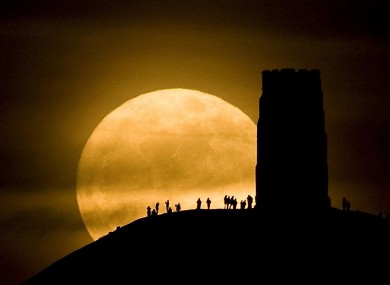
  Last year's 'super moon' near Glastonbury, England
Last year's 'super moon' near Glastonbury, England  
IF YOU’RE WONDERING why the moon seems especially bright and wondrous this weekend, it could be one of two things.

Either you’re head-over-heels in love,  or you’re seeing the ‘super moon’ – the biggest and brightest full moon of the year.
The moon will appear larger and brighter this weekend because it’s closer to us. Its orbit isn’t perfectly circular, so the distance from the Earth’s surface varies. And the full moon due for Saturday evening coincides with the moon passing nearest to us.
“What this means is when you look at it it’s going to be brighter,” David Moore of Astronomy Ireland told TheJournal.ie.
It will be 25 per cent brighter than the most distant full moon, and 10 per cent wider than the furthest full moon.
If the skies are clear, Moore said Earthbound viewers should take the opportunity to have a look. “The moon is always a fantastic sight in a telescope,” he said.
However, he said those not expecting the ‘super moon’ might not be aware of the event. “There’s always been a debate about whether people would notice.”
The ‘super moon’ will also mean that tides are more dramatic than usual – rising and falling to higher and lower extremes.
Last year skywatchers around the world turned out in March as the moon came closer to Earth than it had for almost 20 years